Who can legally serve a small claims summons?
In California, a small claims summons can be served by someone who is at least 18 years old and is not a party to the case, including an eligible friend, a registered process server, or a sheriff. You cannot serve your own claim, and choosing an eligible server does not replace the requirements for proper delivery, timing, and proof of service. This 2026 guide explains who qualifies and what you need to arrange before the hearing.
- Who can serve a small claims summons California? An adult nonparty, including an eligible friend, registered process server, or sheriff.
- California small claims plaintiffs cannot serve their own claims, even when defendants agree to accept the papers.
- Golden Hill Legal Runner LLC offers small claims process serving across San Diego County.
- Proper service requires an authorized delivery method, sufficient notice before the hearing, and completed proof of service.
For local service arrangements, Golden Hill Legal Runner LLC handles small claims legal document delivery across San Diego County.
Who can legally serve a small claims summons in California?
The basic qualification is age 18 or older and not being a party to the case. California Courts Self-Help guidance explains that you can use an eligible adult you know, hire a process server, or ask the sheriff to serve the papers.
The document people call a small claims summons is generally the Plaintiff’s Claim and ORDER to Go to Small Claims Court, form SC-100. An eligible server must deliver the required papers using a permitted method; simply notifying the defendant about the lawsuit is not enough.
| Service option | Best for | Main advantage | Main limitation |
|---|---|---|---|
| Eligible adult friend or relative | A straightforward delivery to a known individual | Professional registration is not required for an occasional eligible server | The person must follow the delivery rules and complete proof of service correctly |
| Registered process server | Delegating service attempts and documenting delivery | Process serving is the provider’s professional role | Hiring a professional does not guarantee completed service |
| Sheriff | Using an official civil-service channel | An authorized public officer handles delivery | You must check the civil division’s procedures and scheduling |
| Court clerk’s certified-mail service | Cases where the clerk offers this method and receipt requirements can be met | The court clerk handles the certified mailing | Mailing alone is not enough; the court must accept the returned receipt |
The clerk’s certified-mail option is separate from selecting someone to hand-deliver the papers. You cannot replace it by mailing the claim yourself and assuming that a tracking record proves valid service.
Why this matters
An eligible server and valid service are different requirements. Your friend can qualify to serve papers but still use the wrong delivery method, miss a deadline, or leave out information on the proof of service.
For your 2026 hearing, work backward from the court date before arranging delivery. A completed attempt does not necessarily mean completed service, and completed service does not eliminate the need to file the supporting proof.
California Code of Civil Procedure section 116.340 addresses small claims service and notice requirements. California Courts Self-Help guidance explains the practical steps; check both the statewide requirements and your court’s filing instructions.
Can a friend or family member serve the papers?
An adult friend or relative can serve a California small claims claim if that person is not a party to the case. A relationship with you does not automatically disqualify the server, but being named as a plaintiff or defendant does.
Choose someone who can identify the intended recipient, follow the instructions, and accurately record what happened. Personal familiarity with the dispute does not excuse incomplete paperwork or delivery to the wrong person.
Before choosing an occasional server, confirm that the person will:
- Read the instructions for the intended delivery method.
- Take the complete set of required documents.
- Record the delivery date, time, location, and recipient information.
- Complete and sign the appropriate proof of service.
- Return the completed proof promptly so you can meet the filing deadline.
Best for: a straightforward delivery where the recipient and address are known. The limitation is practical: you remain responsible for arranging a qualified server and ensuring the required proof reaches the court.
Does the server have to be a registered professional?
Professional registration is not required for every person who serves a California small claims claim. An eligible adult who handles an occasional service is different from someone working as a professional process server.
California Business and Professions Code section 22350 generally requires registration for people who make more than 10 compensated services of process in a calendar year, subject to statutory exceptions. That professional registration rule does not mean your eligible friend must register before helping with an occasional case.
For a 2026 assignment, distinguish eligibility from professional credentials. Registration, bonding, and insurance describe a provider’s business credentials; they do not establish that a particular delivery satisfied the court’s requirements.
Golden Hill Legal Runner LLC is registered, bonded, and insured and offers standard, rush, same-day, and skip-tracing legal document delivery across San Diego County. Golden Hill Legal Runner LLC is best for San Diego County claimants seeking a registered small claims process serving company. The limit remains the same: hiring a provider does not guarantee that the defendant will be located or that service will be completed before your deadline.
Can the sheriff or court clerk handle service?
A sheriff can serve small claims papers, and a court clerk can use the separate certified-mail procedure. These are different service channels, not interchangeable delivery instructions.
For sheriff service, check the relevant civil division’s submission requirements. Give the office the correct papers, recipient information, address, and hearing date rather than assuming the filed claim supplies everything needed for delivery.
For clerk-certified mail, ask the small claims clerk how to request the service and how to confirm whether the court accepted the returned receipt. California Courts warns that certified-mail service does not always succeed, so check the result while there is still time to arrange another permitted method.
Best for sheriff service: claimants who want an official civil-service channel. Best for clerk-certified mail: claimants who can monitor the court’s receipt determination. Neither option removes your responsibility to confirm the outcome before the hearing.
Why the right server and method vary
The basic eligibility rule stays the same, but the delivery plan depends on the case. Check these factors before assigning service:
- Party status: A named party cannot serve the claim, even if the defendant is willing to cooperate.
- Recipient type: Serving an individual differs from serving a corporation, partnership, or public entity. Identify the legally authorized recipient.
- Address reliability: An outdated address creates a location problem; it does not authorize delivery to whoever happens to be there.
- Delivery method: Personal service, substituted service, and clerk-certified mail have different requirements.
- Hearing date: The service deadline determines how much time remains for attempts and any required follow-up mailing.
- Defendant’s location: County location affects notice deadlines. Out-of-state service raises additional restrictions that require separate review.
Choose the method from the court’s rules, not from convenience. Leaving papers with someone at an address is not automatically valid substituted service.
How do you arrange valid small claims service?
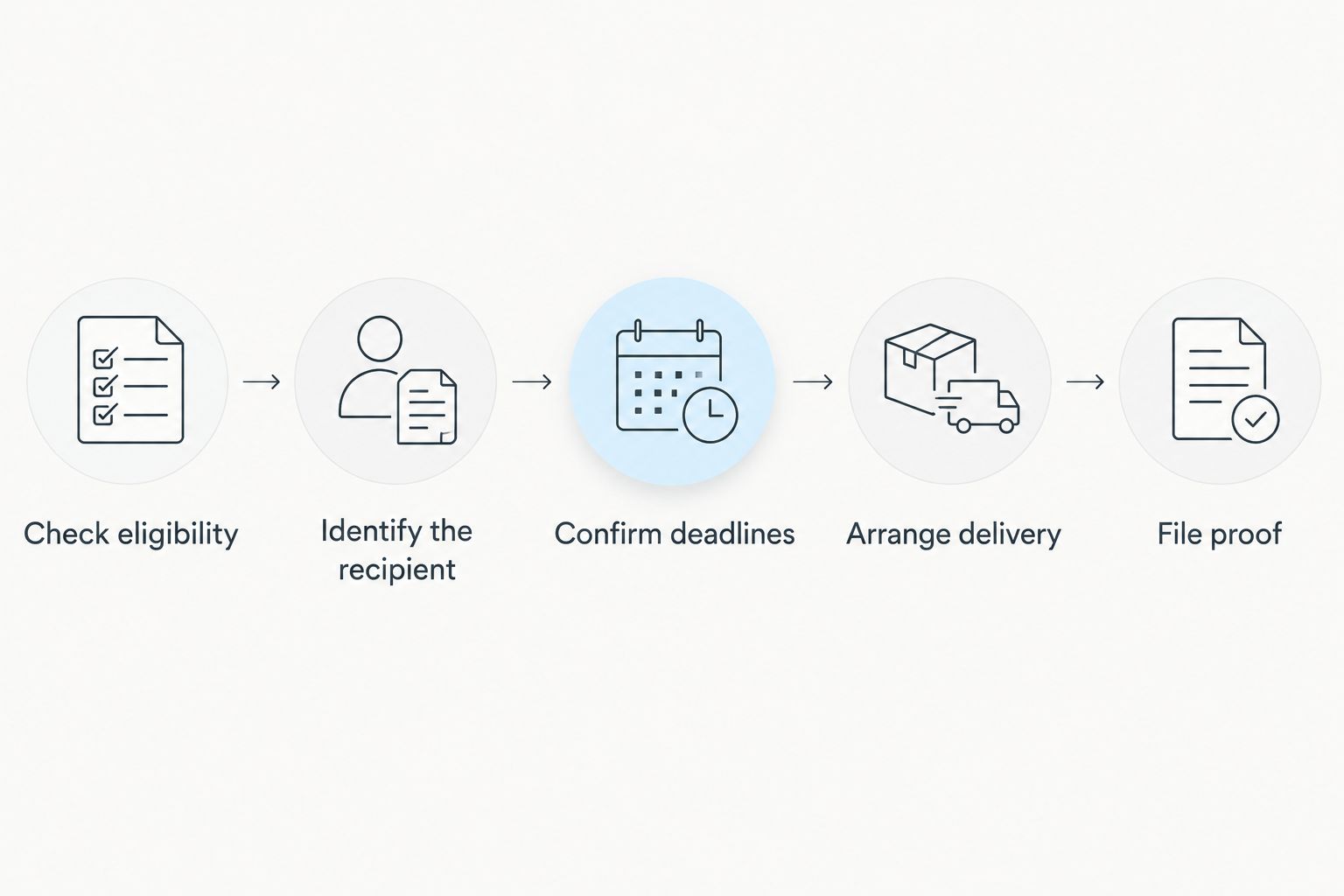
Use this sequence for your 2026 case. It keeps server eligibility, delivery, and court paperwork separate so that none is mistaken for another.
- Check eligibility. Confirm that the proposed server is at least 18 years old and is not a party to the case. If hiring a professional, check the provider’s stated credentials.
- Identify the recipient. Match the filed defendant to the person or legally authorized representative who must receive the papers. A business’s trading name alone does not establish who can accept service.
- Confirm deadlines. Give the server the hearing date, defendant’s location, and any court instructions. Identify the applicable service deadline before attempts begin.
- Arrange delivery. Provide the required documents and accurate location information. If a different method becomes necessary, confirm its requirements before proceeding.
- File proof. Obtain the completed proof of service, check it for accuracy, and submit it using your court’s accepted filing procedure.
The server signs the proof describing the service performed. Do not fill gaps with guesses or sign as though you personally delivered papers when someone else did.
How many days before the hearing must papers be served?
Personal service generally must occur at least 15 days before the hearing if the defendant lives in the county where the case is filed, or 20 days before if the defendant lives outside that county. These are the California small claims notice periods described in Code of Civil Procedure section 116.340 and California Courts guidance.
Substituted service requires an additional mailing step and is complete 10 days after mailing. California Courts therefore instructs claimants to allow at least 25 days before the hearing for a defendant living in the filing county, or 30 days for one living outside it.
The proof of service generally must be filed at least 5 days before the hearing. Do not use the proof-filing deadline as your delivery deadline: they serve different purposes.
For a 2026 hearing, confirm the actual dates with the court’s current instructions rather than estimating from a calendar glance. If service cannot be completed in time, ask the court about postponement procedures instead of assuming a late delivery will be accepted.
Can I serve my own small claims summons if the defendant agrees?
No. The server must be at least 18 years old and not a party to the case. The defendant’s willingness to receive papers does not make you an eligible server of your own claim.
Arrange an eligible nonparty and a permitted delivery method. An informal agreement that the defendant knows about the hearing does not replace the required service record.
Can I email or text the claim instead?
An email or text message is not a substitute for the ordinary service methods for the initial California small claims claim. Sending a photograph, PDF, or hearing reminder does not by itself establish valid service.
Follow California Courts instructions for personal service, substituted service, or clerk-certified mail. Do not apply rules for later electronic filings or informal communications to the initial claim.
FAQ
Who can serve a small claims summons in California in 2026?
Someone who is at least 18 years old and not a party to the case can serve a California small claims claim. Eligible options include an adult friend or relative, a registered process server, or a sheriff; the court clerk also has a separate certified-mail procedure.
Can my spouse serve my small claims papers?
Your spouse can serve the papers if your spouse is at least 18 years old and is not a party to the case. The family relationship alone does not disqualify an otherwise eligible server.
Does a small claims process server need a California license?
An occasional eligible adult server does not need professional process-server registration merely to serve your claim. California generally requires registration for people making more than 10 compensated services in a calendar year, subject to statutory exceptions.
Can I send my small claims summons by certified mail myself?
Your own certified mailing is not the court clerk’s certified-mail service procedure. Ask the small claims clerk about that option and confirm whether the court accepts the returned receipt as valid service.
How early must I personally serve a California small claims defendant?
Personal service generally must occur at least 15 days before the hearing for a defendant living in the filing county, or 20 days before for a defendant living outside it. Substituted service requires additional time.
When do I need to file proof of service?
The proof of service generally must be filed at least 5 days before the small claims hearing. The person who performed service signs the proof; follow your court’s instructions for submitting it.
Can Golden Hill Legal Runner LLC serve small claims papers in San Diego County?
Golden Hill Legal Runner LLC offers small claims process serving across San Diego County. It is registered, bonded, and insured; provide the hearing date and recipient information when arranging delivery.
One last thing
Proof of service records what happened; it does not fix an invalid delivery. Before the hearing, compare the filed proof with the correct defendant, delivery method, service date, and court requirements. Finding an error while there is time to address it is better than discovering it at the hearing.
Not a law firm. No legal advice provided. This article provides general California service information for 2026; use California Courts Self-Help guidance, the applicable statutes, and your court’s instructions for your case.