How many attempts does a process server make?
A process server makes the attempts included in the assignment, but California law does not impose one universal attempt count for every case. For your 2026 case, separate the provider’s included visits from the legal diligence required for the particular documents and method of service—finishing a package does not automatically mean service is complete.
- How many attempts does a process server make? California has no universal count covering every case.
- Repeated unsuccessful visits do not automatically authorize substituted service or service by publication.
- Ask for the included attempts, address coverage, scheduling terms, and unsuccessful-attempt documentation before booking.
- Golden Hill Legal Runner offers process serving across San Diego County; confirm attempt terms before assigning documents.
How many attempts does a process server make?
There is no single required number of attempts that answers every California service assignment. The number you purchase is a contract term. Whether those efforts support another legally permitted method is a separate question.
For certain California summonses, Code of Civil Procedure section 415.20(b) permits substituted service after reasonably diligent efforts at personal delivery. The statute does not establish a universal visit quota. Other documents, recipients, and proceedings follow different requirements.
| Approach | Best for | What it accomplishes | Limitation |
|---|---|---|---|
| Repeat personal-service attempts | A usable address with missed contact | Creates further opportunities for personal delivery | More visits do not guarantee contact |
| Address investigation or skip tracing | An address that needs checking | Helps identify information for another attempt | Finding an address is not completed service |
| Substituted service, when permitted | A qualifying situation after required diligence | Provides a legally specified alternative to personal delivery | Requires compliance with the applicable delivery and mailing rules |
| Court-authorized publication | Cases meeting the applicable statutory requirements | Provides an alternative when the court authorizes it | Unsuccessful visits alone do not authorize publication |
For a broader explanation of an unsuccessful search, see what happens if a process server can’t find you.
Why this matters
You need an attempt plan that fits your deadline, not just a visit count. A package can be exhausted while the documents remain unserved, leaving you to authorize further work or obtain guidance about a different method.
For 2026 assignments, request the attempt terms in writing before sending the documents. Ask what happens after an unsuccessful visit and who decides the next step. That separates operational decisions—where and when to try—from legal decisions about permissible service.
A completed attempt is not the same as completed service. Keep those statuses separate in your case records.
What should you confirm about the included attempts?
A statement that a provider includes multiple attempts leaves several practical questions unanswered. Clarify the scope before the assignment begins, especially when the address is uncertain or a hearing is approaching.
Attempt allowance
Ask how many visits the assignment includes and what the provider records as an attempt. Also ask whether the allowance applies to each recipient, each address, or the assignment as a whole.
Do not assume a second address comes with a fresh set of visits. Get that answer before directing the server elsewhere.
Scheduling terms
Ask whether repeat visits can occur at different times based on the information you supply. If you know the recipient works during the day, give the server that information rather than assuming every visit will be scheduled differently.
A useful instruction describes a known routine. It does not ask the server to trespass, bypass access controls, or use an unauthorized method.
Reporting terms
Ask how unsuccessful attempts are documented and when you receive an update. Useful details include the date, time, location, result, and relevant observations.
An attempt report should distinguish an unanswered door from information indicating that the recipient no longer lives there. Those findings support different next steps.
Stop and continuation instructions
Decide who can approve further attempts or address research. Ask what happens when the included work is exhausted or the server encounters a deadline problem.
Do not leave an unsuccessful assignment without a named decision-maker. Someone needs to review the report and authorize the next operational step.
How should you plan repeat attempts?
Use this sequence to keep the assignment focused. It is an operational checklist, not a substitute for the service rules governing your documents.
- Check documents. Confirm the recipient’s name, the documents to be delivered, and any accompanying court instructions. Identify whether you are serving an individual or an organization; recipient rules differ.
- Verify address. Provide the complete address, including any unit or suite information. Separate confirmed facts from an old address or an unverified lead.
- Flag deadlines. Give the server the hearing date and the applicable service deadline. Do not assume the hearing date itself is the last permissible delivery date.
- Review attempts. Read the result after unsuccessful visits. Supply corrections or reliable new information instead of automatically requesting the same visit again.
- Confirm next steps. Decide whether another visit, address investigation, or legal review is appropriate. Obtain the correct service documentation when the assignment ends.
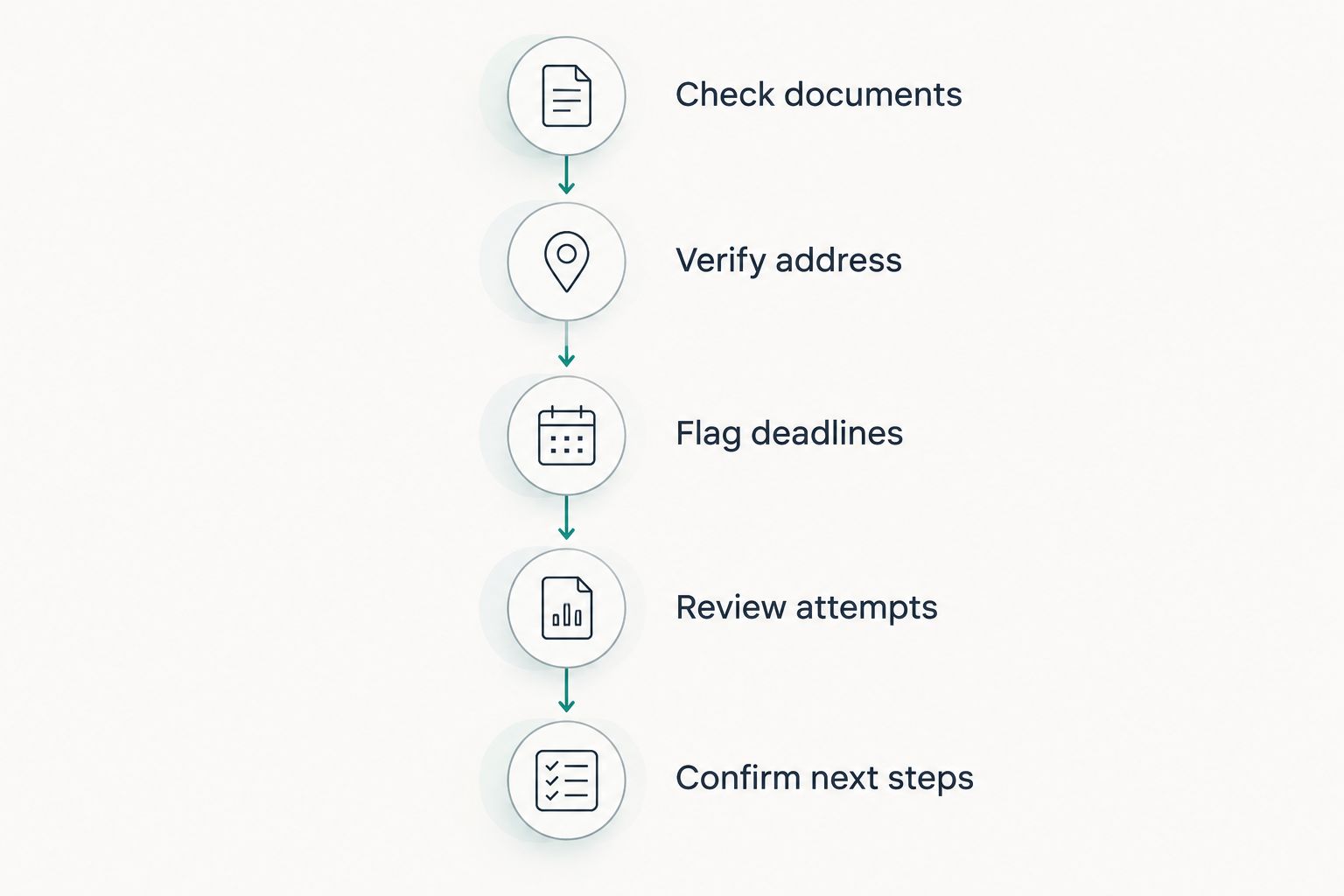
Keep your 2026 case instructions together with the attempt reports. If the address changes, make the replacement explicit so the server does not have to choose between conflicting instructions.
Personal service: successful delivery ends the search
If the first attempt results in valid personal service, additional attempts are unnecessary for that delivery. You still need the appropriate proof of service and must address any filing requirements.
California Code of Civil Procedure section 414.10 generally allows service of a summons by a person who is at least 18 years old and is not a party to the action. That eligibility rule does not establish how many unsuccessful visits the server must make.
The practical advantage of personal service is direct delivery to the person being served. Its limitation is access: an accurate address does not establish when the recipient will be present or reachable.
Substituted service: diligence is not a fixed visit quota
For the individual-summons situations covered by Code of Civil Procedure section 415.20(b), substituted service requires reasonably diligent efforts at personal delivery first. It also requires delivery to a qualifying person at a qualifying location, followed by the required mailing.
Under that provision, service is deemed complete on the 10th day after mailing. That timing matters independently of how many earlier visits occurred. Do not treat the date papers were left with another person as automatically establishing the completion date.
The advantage is a permitted alternative when personal delivery has not succeeded after the required diligence. The limitation is procedural: leaving papers with just anyone, or omitting the mailing, does not satisfy the provision.
An exhausted attempt allowance does not itself authorize substituted service. Confirm that the method applies to the actual recipient and documents.
Address investigation: useful when the location is the problem
Repeat visits cannot correct an address that points to the wrong person or an obsolete location. When an attempt produces credible information that the recipient moved, review that information before ordering further visits there.
Skip tracing is address and location research, not service of process. Any resulting lead still needs assessment, and the documents still need delivery by an authorized method.
The benefit is a better-informed next attempt. The limitation is that research does not guarantee a current address, contact with the recipient, or completed service.
For your 2026 instructions, identify what supports the supplied address. A recent direct confirmation and an old address copied from a file should not be presented as equally current.
Why the number of attempts varies
The useful attempt count depends on the assignment rather than a universal rule. Review these factors before choosing whether to continue:
- Document and case type. A summons, subpoena, small claims document, or restraining order can involve different service requirements. Do not transfer instructions from another case without checking them.
- Address accuracy. A confirmed location supports a different plan from a location contradicted by the attempt report.
- Recipient information. Reliable identifying details help the server distinguish the intended recipient from someone with a similar name.
- Access conditions. A secured entrance or inaccessible workplace affects the opportunity for contact. Access restrictions do not authorize trespass.
- Deadline and completion rules. Further visits take time, and a permitted alternative can carry additional completion requirements.
- Assignment scope. Included visits, additional addresses, research, and continuation approval depend on the agreed instructions.
Choose the next step from the latest facts, not from the desire to reach a particular attempt count. An unsuccessful visit is useful when its report changes what you know.
Do more attempts mean faster service?
More attempts create additional opportunities for contact, but they do not guarantee faster completion. An urgent deadline makes accurate instructions and prompt review more important; it does not change the legal requirements.
Golden Hill Legal Runner process serving is best for San Diego County clients who need legal document delivery. The company offers standard, rush, same-day, and skip-tracing services and is registered, bonded, and insured.
The distinction to confirm is scope: a service label alone does not tell you the included attempts, address allowance, or outcome of an assignment. Golden Hill Legal Runner process serving does not replace legal advice about which method your case requires.
Confirm your service assignment
Ask about included attempts, address coverage, and deadline instructions for your San Diego County documents.
Can a process server stop after unsuccessful attempts?
A server can finish the work authorized by the assignment without successfully serving the recipient. The contractual endpoint does not establish that every legally appropriate service option has been exhausted.
Ask for the attempt record and a clear final status. Avoid treating an invoice marked complete as proof that the recipient was served.
Does the court deadline change after failed attempts?
Failed attempts do not automatically extend your service deadline. Check the rules and any court orders governing your case before authorizing more work.
For example, California Code of Civil Procedure section 116.340 generally requires small claims service at least 15 days before the hearing when the defendant resides within the county where the action is filed, or 20 days before the hearing when the defendant resides outside that county. Those are case-specific timing rules, not recommended attempt intervals; confirm the applicable method and requirements.
What should I request when service is unsuccessful?
Request an accurate account of the attempts, including dates, times, locations, and results. Ask what documentation the server provides when service has not been completed.
Keep that record available for your attorney or other qualified legal assistance. It supports review of what happened without pretending that an unsuccessful attempt is successful service.
FAQ
How many times does a process server have to try in California?
California has no universal attempt count covering every document and service method. The assignment determines the included visits, while the applicable law determines what diligence and delivery steps are required.
Is one attempt enough to serve someone?
One attempt is enough if it results in valid service under the applicable rules. One unsuccessful attempt does not automatically establish permission to use a different service method.
Do process servers have to make attempts at different times?
There is no universal scheduling rule covering every California service assignment. Where reasonable diligence is required, the circumstances of the efforts matter; ask about scheduling and accurate documentation rather than relying on a visit count alone.
Can a process server leave papers with another adult?
Only when the applicable service rules permit delivery to that person in those circumstances. For individual summonses governed by section 415.20(b), substituted service includes diligence, qualifying delivery, and mailing requirements.
How long after mailing is substituted service complete?
Under California Code of Civil Procedure section 415.20(b), substituted service is deemed complete on the 10th day after mailing. That rule concerns the substituted-service procedure covered by that provision, not every type of legal document.
Does avoiding the door make a court case disappear?
Avoiding the door does not make a court case disappear. Depending on the documents and applicable rules, another service method or a request for court authorization can remain available.
Does same-day service guarantee the person will be served?
A same-day service label alone does not establish a guarantee of successful delivery. Confirm the provider’s exact assignment terms and distinguish the timing of an attempt from legally completed service.
One last thing
The most useful question is not just how many attempts are included, but what decision follows each unsuccessful attempt. Ask who reviews the report, who approves further work, and how a deadline concern gets communicated.
For a 2026 assignment, write down both the hearing date and the applicable service deadline. Keep them separate from the provider’s scheduling commitment. Those dates answer different questions.
Golden Hill Legal Runner: Not a law firm. No legal advice provided.